Operator and dispute details
Shuffle License, Operator Record and Player Safety
Shuffle is owned and operated by Natural Nine B.V. and lists Curaçao gaming licence OGL/2024/1337/0628. That structure matters most when a dispute leaves ordinary account support and moves into formal complaint territory: the licence record, the evidence you keep and the route available from your own country become separate questions.
The operator record behind Shuffle
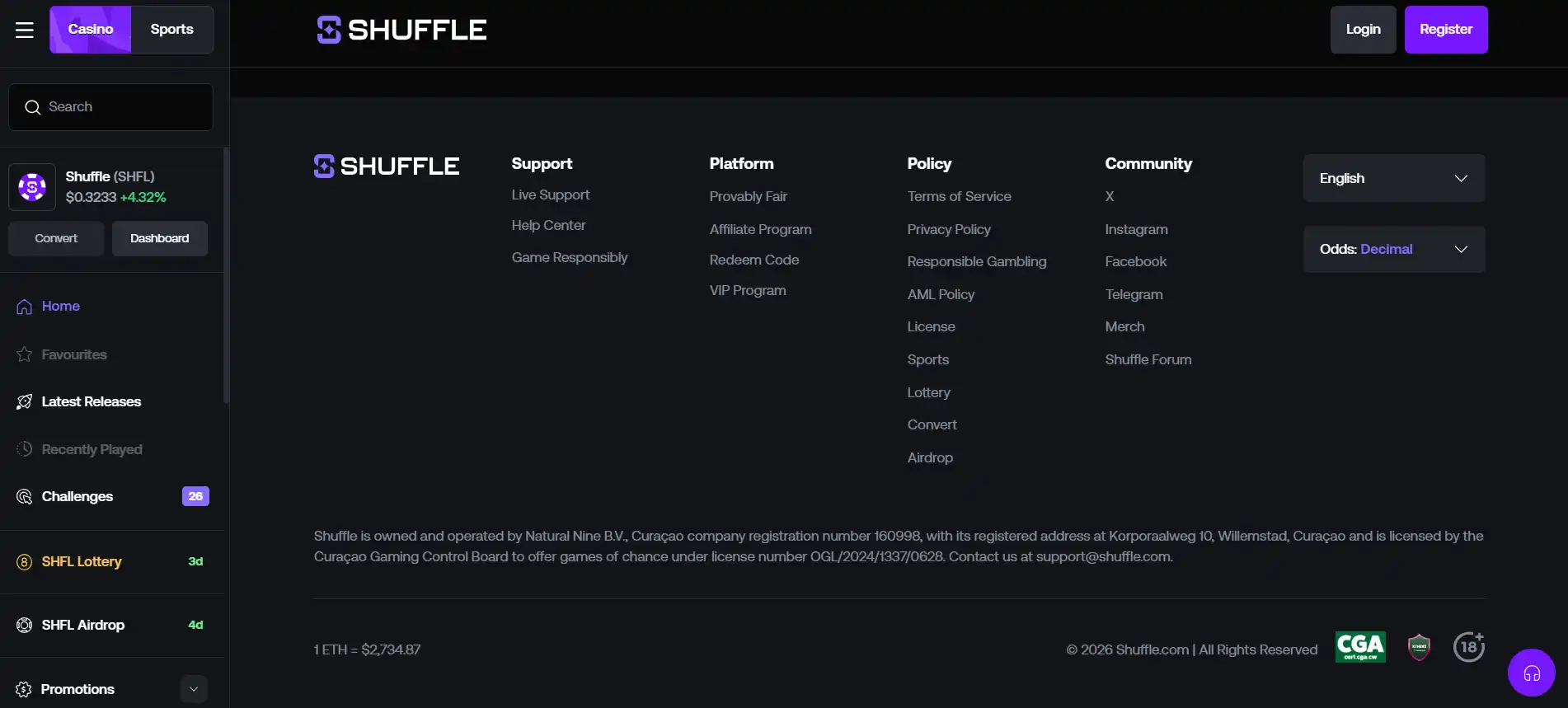
The company behind Shuffle is Natural Nine B.V., Curaçao company registration number 160998. Shuffle lists Curaçao gaming licence OGL/2024/1337/0628. For a player, the useful question is not whether a badge looks reassuring; it is whether the operator identity, the licence reference and the account evidence all point to the same service if a dispute has to be recorded.
- OperatorNatural Nine B.V.
- Licensing jurisdictionCuraçao
- Licence numberOGL/2024/1337/0628
- Operating modelOffshore crypto casino
- Security historyThird-party CRM data incident acknowledged in October 2025
Shuffle currently identifies licence number OGL/2024/1337/0628 in its terms and site footer. Older Curaçao licensing structures used different frameworks, so older account records may contain historical licensing details that differ from the current licence.
An offshore licence is not the same thing as a local licence in your country. It identifies the operator’s licensing jurisdiction; it does not establish that gambling with Shuffle is lawful where you live. Check the gambling laws that apply in your own country.
The rest of the site keeps this regulatory layer separate. If your immediate concern is transaction mechanics, use the Shuffle payments guide. If the problem starts with identity checks or account access, the Shuffle account guide is the more useful first stop.
What the Curaçao licence means — and what it does not
Curaçao is the licensing jurisdiction attached to Shuffle in the operator record. That gives you a jurisdiction to identify when documenting the business, but it should not be stretched into a promise about local consumer protection, local legality or a guaranteed remedy. Those questions depend on the rules that apply to you and on the current powers and procedures attached to the operator’s licence.
| Record | What it establishes | What still needs checking |
|---|---|---|
| Natural Nine B.V. | The company identified behind Shuffle. | Whether the operator details displayed in your account or terms still match when a dispute arises. |
| Curaçao | The offshore licensing jurisdiction attached to the operator. | Your own country’s gambling rules and the practical complaint route available to you. |
| OGL/2024/1337/0628 | The licence number displayed by Shuffle. | The current registry entry and any later change to the entry or its scope. |
A licence number is most useful as a matching field. If you ever need to escalate a complaint, compare the company name, the domain, the reference number and the transaction or account record that produced the dispute. A mismatch between those pieces is more actionable than a general feeling that a casino “looks licensed.”
The practical limitation of an offshore setup is distance from the player’s home jurisdiction. You should not assume that a national gambling authority where you live supervises Shuffle or can order a remedy. At the same time, the absence of a local licence does not by itself answer whether you are allowed to use the site. Local law is a separate check.
Build a dispute path before you need one
A strong dispute file starts before escalation. Crypto transfers can be irreversible, account checks can add time to a withdrawal, and support conversations can become difficult to reconstruct later. The aim is to keep enough evidence that another party can understand what happened without relying on memory.
- Save the transaction ID, asset, network, amount and wallet addresses for the transfer at issue. For crypto, the chain record is often the cleanest timestamped evidence.
- Keep the account-side record: withdrawal request, verification request, account messages and any support ticket reference connected to the same event.
- Ask platform support for a specific resolution in writing. Separate a payment delay, an identity-check request and an account restriction instead of treating them as one vague complaint.
- If ordinary support does not resolve the issue, assemble the operator identity, licence number and transaction evidence before approaching a complaint service or the relevant licensing channel.
- Check the gambling laws and available help routes in your own country. An offshore operator’s licence does not replace local legal advice or create a national complaint body where none applies.
Evidence that travels well
- Blockchain transaction IDs and wallet addresses.
- Dated account and withdrawal records.
- Copies of support messages and case references.
- The operator name and licence reference shown at the time of the dispute.
Assumptions that weaken a complaint
- Treating a promotional headline as the full contractual term.
- Assuming a routine withdrawal speed is a guaranteed deadline.
- Assuming registration without an ID check means verification can never be requested later.
- Assuming an offshore licence automatically gives you a regulator in your home country.
If the dispute is specifically about a cashout, the payments section gives the broader transaction context and the dedicated withdrawal guide goes deeper into amount, network and verification friction. The Shuffle review puts those mechanics back into the wider casino picture.
KYC requirements can affect when a withdrawal is released
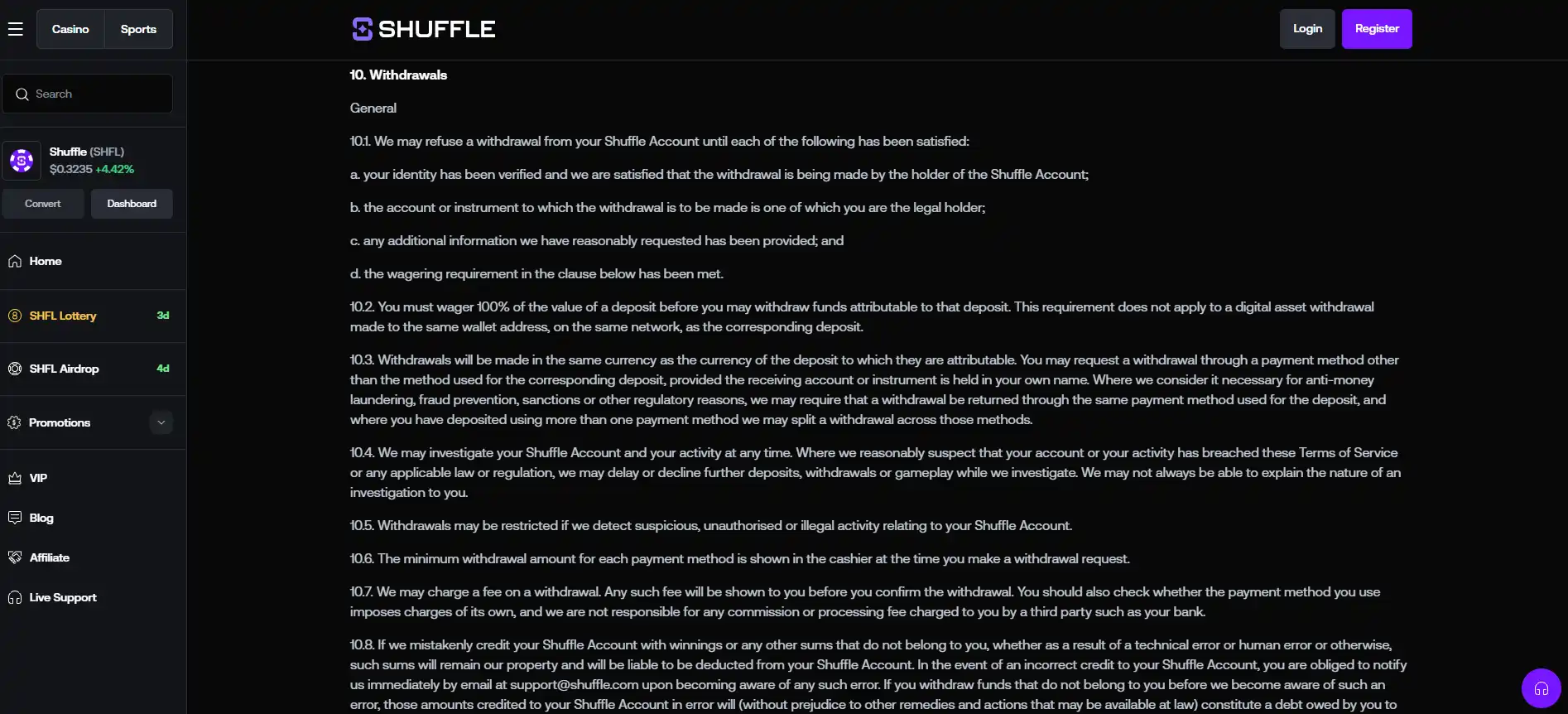
Shuffle’s terms allow identity checks at a threshold set by the operator and require a valid government-issued identity-document check before the first withdrawal. Electronic checks, payment-instrument validation, database checks and selfie verification can be added when required. That makes “no-KYC” an inaccurate description of the withdrawal process.
Shuffle can restrict access to payments or withdrawals until identity has been established to its satisfaction. It can also request evidence of source of funds or source of wealth and may require a payment method used for a deposit or withdrawal to be shown as belonging to the account holder. These checks are account conditions that can delay release before any blockchain transfer begins.
First withdrawal
A government-issued identity-document check is required before release.
Possible checks
Government ID, proof of address and liveness or selfie verification can be requested.
Additional checks
Electronic, payment-method, database, selfie and source-of-funds checks can be requested.
Practical preparation
Keep account details consistent and be ready to supply requested documents securely if verification is triggered.
A short sign-up flow does not remove later verification risk. If you would be unwilling or unable to provide identity documents, that matters before you place funds at risk, not only after a withdrawal is paused.
The October 2025 incident changed the privacy context
In October 2025, Shuffle notified users about a data security incident involving third-party CRM and email provider Fast Track. The notice said an unauthorised party obtained user emails, names, addresses, transaction data and betting data.
The notice stated that passwords and login credentials were not stored with Fast Track and that Shuffle accounts and player funds remained secure. Names, addresses and transaction or betting data can still increase phishing and impersonation risk even when account credentials are not part of the exposed dataset.
Identity exposure
Names, email addresses and home addresses can make phishing attempts more convincing long after the initial incident.
Behavioral exposure
Transaction and betting data can reveal account activity beyond what a simple contact list would contain.
Account access and funds
The user notice stated that passwords or login credentials were not stored with Fast Track and that Shuffle accounts and player funds were secure.
For current users, the sensible response is operational rather than dramatic: use unique credentials, treat unexpected account or KYC messages with suspicion, navigate to the service directly rather than through unsolicited links, and keep your own record of any verification documents you submit. The incident came through a third-party vendor, which is a reminder that account privacy depends on more than the casino login screen alone.
Keep operator, account and transaction records together
For Shuffle, the operator identity, licence number, account notices and transaction records each serve a different purpose. Natural Nine B.V. and licence OGL/2024/1337/0628 identify the business and its licensing jurisdiction. Deposit and withdrawal records show what happened on the account, while a blockchain transaction ID shows what happened after a crypto transfer was broadcast.
Keep those records together when money is at issue. A withdrawal can be held before broadcast while identity or source-of-funds checks are completed; once a crypto transfer is sent, the network record becomes the key routing evidence. The October 2025 Fast Track incident also makes it sensible to keep account-security messages separate from unsolicited email and to use two-factor authentication.
Save transaction IDs, account notices and support case numbers in a form you can access even if the account itself becomes unavailable.
Common questions about Shuffle licensing and safety
Who operates Shuffle?
Shuffle is owned and operated by Natural Nine B.V., Curaçao company registration number 160998.
What licence number is associated with Shuffle?
The current Shuffle licence number is OGL/2024/1337/0628. Historical account material can refer to earlier Curaçao licensing structures.
Does a Curaçao licence make Shuffle legal in every country?
No universal country-level conclusion follows from the operator’s offshore licence. Gambling rules depend on your own jurisdiction, so check the laws that apply where you live.
Does Shuffle have a fixed no-KYC policy?
No. Shuffle requires a government-issued identity-document check before the first withdrawal and can request additional address, payment or selfie checks when necessary.
What happened in the October 2025 Shuffle data incident?
In October 2025, Shuffle notified users about an incident involving third-party CRM and email provider Fast Track. The notice described names, email addresses, addresses, transaction data and betting data as exposed, while stating that passwords or login credentials were not stored with Fast Track and player funds remained secure.
What should I keep if I have a dispute?
Keep transaction IDs, wallet and network details, withdrawal records, verification requests and support correspondence. Those records make it easier to separate a payment issue from an account or identity-check issue.
Read next
- Understand Shuffle account checks and KYC
- Review Shuffle payment and network mechanics
- Return to the full Shuffle review
Shuffle’s offshore setup puts more weight on records and dispute preparation
Shuffle is operated by Natural Nine B.V. under Curaçao gaming licence OGL/2024/1337/0628. That offshore licence does not replace the gambling laws that apply where you live. Shuffle requires an identity-document check before the first withdrawal and can request additional identity, payment-method or source-of-funds evidence. The October 2025 Fast Track incident adds a separate account-security consideration. Keep transaction IDs, account notices and support records together so payment, verification and blockchain events can be distinguished if a problem arises.
Created by the ”Shuffle” editorial team.