In-house casino games
Shuffle Originals and How Provably Fair Gaming Works
Shuffle has its own Originals category with games including Crash, Plinko, Mines, Dice, Limbo, Keno, Hilo, Wheel, Blackjack, Roulette and Tower. These titles use provably-fair algorithms, which means the result can be tied to cryptographic inputs rather than treated as an unexplained black box. That improves outcome transparency, but it does not make the next result predictable or remove the mathematical risk of gambling.
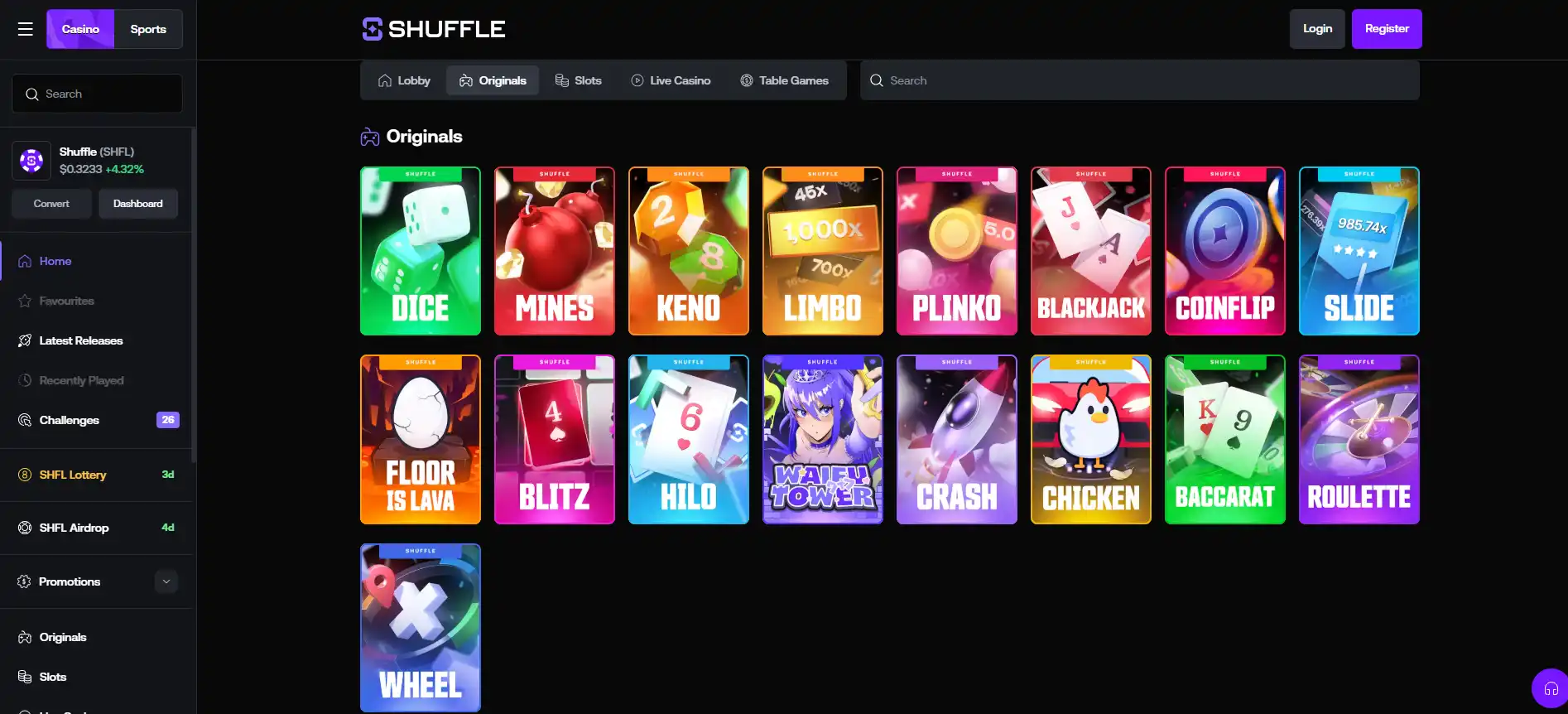
Shuffle Originals cover several instant-game families
The in-house catalogue is not one repeated mechanic with different skins. Named Shuffle Originals span multiplier games, grid-based choices, dice-style outcomes, number games and casino-table adaptations.
- Multiplier-style examplesCrash and Limbo
- Choice and grid examplesMines and Tower
- Chance-format examplesDice, Plinko, Keno and Wheel
- Table adaptationsBlackjack and Roulette
- Fairness modelProvably fair
| Originals family | Named examples | Practical focus |
|---|---|---|
| Multiplier games | Crash, Limbo | Understand how the multiplier mechanic works before deciding when a round ends for you. |
| Grid and selection games | Mines, Tower | Each choice changes the path through the round, so read the game rules before starting. |
| Chance visualisations | Dice, Plinko, Keno, Wheel | The presentation differs, but each remains a gambling game with variable outcomes. |
| Casino-table adaptations | Blackjack, Roulette | Do not assume the digital version uses the exact same interface or options as a streamed live table. |
The wider Shuffle games guide separates these in-house titles from third-party providers and live casino games. If you want a streamed dealer rather than an instant-result interface, the Shuffle live casino guide is the more relevant branch.
Provably fair links a round to cryptographic inputs
Shuffle describes its Originals as provably fair. In practical terms, provably-fair systems use cryptographic values so a completed result can be checked against the inputs that produced it. The usual building blocks are a server-side value, a player-side or client value, and a cryptographic hash or commitment that prevents the hidden input from being changed after the fact.
Server seed
A server seed is a secret input held by the game system for a period of play. A cryptographic commitment can be shown before the seed is revealed, allowing a later check that the hidden value was not swapped retroactively.
Client seed
A client seed contributes another input to the result. The key idea is that the outcome is not based on a server value alone, giving the player side a role in the deterministic calculation.
Nonce or round counter
Many provably-fair systems include a changing round counter so repeated bets with the same seed pair still produce different deterministic outputs.
Hash check
After the relevant secret is revealed, hashing it again lets you compare the result with the earlier commitment. Matching values show that the committed input remained the same.
That is the general mechanism. The exact controls and data shown to a player depend on the individual game interface. Use the seed, hash and result information presented by the specific Original you are playing rather than assuming every title exposes identical controls.
For most players, the practical benefit is auditability after the fact. You do not need to treat every round as a cryptography exercise, but knowing what the seed and hash fields mean makes it possible to investigate a result instead of relying only on the animation shown on screen.
Seed and hash checks answer a narrow but useful question
A provably-fair check is best understood as a consistency test. It helps answer whether the completed result corresponds to the committed cryptographic inputs. It does not answer whether the game is suitable for your bankroll, whether the next round will win, or whether a losing streak is likely to reverse.
- Before or during play, identify the seed or hash information exposed by the game interface.
- After the relevant server value is revealed, compare it with the earlier cryptographic commitment.
- Combine the revealed inputs in the way the game's own verification process specifies.
- Check that the resulting output matches the completed round you actually played.
For readers who have never used provably-fair games, the conceptual shift is simple: a normal opaque game asks you to trust that the random outcome was produced correctly, while a provably-fair game gives you cryptographic material that can be used to check a finished result. That is a meaningful transparency feature, but only within the scope of the round data the game exposes.
Provably fair does not change volatility or expected loss
Outcome transparency and gambling economics are different questions. A round can be provably fair and still lose. A long losing sequence can be consistent with a fair random process. Likewise, a recent win does not make the next outcome safer or more likely to repeat.
What provably fair can help with
- Checking that a completed round matches the cryptographic inputs used to generate it.
- Detecting whether a committed seed changed after the commitment was made.
- Separating outcome-integrity questions from simple trust in an opaque result screen.
- Giving technically curious players a reproducible way to inspect past rounds when the required data is exposed.
What it does not do
- It does not predict the next result.
- It does not eliminate the game's mathematical advantage.
- It does not prevent variance or losing streaks.
- It does not turn gambling into an investment or a reliable income source.
This separation matters with fast Originals such as Crash, Dice or Plinko because many rounds can be played in a short period. Faster repetition can magnify spending before it feels substantial. Set a budget in ordinary currency terms as well as crypto units, especially when the asset value itself can move during a session.
Match the mechanic to the kind of session you want
The named Shuffle Originals cover enough different mechanics that choosing by title alone is inefficient. Decide first whether you want a multiplier game, a grid or selection mechanic, a pure chance visualisation, or a digital adaptation of a casino-table format. Then read the individual rules before staking money.
- Crash or Limbo
- Best approached as multiplier mechanics where the round structure matters more than the visual theme.
- Mines or Tower
- Choice-driven formats where each selection changes the route through the current round.
- Dice, Plinko, Keno or Wheel
- Chance-led formats with different visual ways of expressing uncertain outcomes.
- Blackjack or Roulette
- Digital casino-table formats that should be read through their own rules rather than assumed to mirror a live studio table exactly.
If you are playing under a promotion, game selection should also be checked against the active wagering terms rather than inferred from the lobby. The Shuffle bonus guide explains the 35x deposit-plus-bonus requirement and why turnover can scale quickly even when the starting deposit looks modest.
Common Shuffle Originals questions
What are Shuffle Originals?
Shuffle Originals are in-house casino games. The Originals range includes Crash, Plinko, Mines, Dice, Limbo, Keno, Hilo, Wheel, Blackjack, Roulette and Tower.
Can Shuffle Originals outcomes be checked cryptographically?
Yes. Shuffle describes its Originals as using provably-fair algorithms, linking outcomes to cryptographic inputs that can be checked after a round.
Can provably fair predict the next result?
No. Provably fair is an integrity mechanism for checking completed outcomes. It does not reveal or predict the next random result.
Is provably fair the same as having no house edge?
No. Fairness verification and game economics are separate. A game can generate outcomes consistently from committed inputs while still having a built-in mathematical advantage.
Which Shuffle Originals are named in the catalogue?
The in-house catalogue includes Crash, Plinko, Mines, Dice, Limbo, Keno, Hilo, Wheel, Blackjack, Roulette and Tower.
Shuffle Originals are clearest when fairness and game risk stay separate
Shuffle Originals give the casino a distinct in-house layer with named games ranging from Crash and Plinko to Mines, Dice, Blackjack and Roulette. Their defining technical feature is provably-fair outcome generation. That can make a completed result more transparent by tying it to cryptographic inputs, but it does not change the central gambling facts: results remain uncertain, losing streaks remain possible, and rapid repeat play can compound losses quickly. Use provably fair to inspect integrity, then judge each Original by its own rules and the amount you are prepared to lose.