Account and verification guide
Shuffle Account 2026 From Sign-Up to KYC Checks
Shuffle uses a short email-based registration flow, but the account is not anonymous or permanently verification-free. Shuffle can request KYC documentation when necessary, and its terms require a government-issued identity-document check before the first withdrawal.
Registration starts with a short email flow
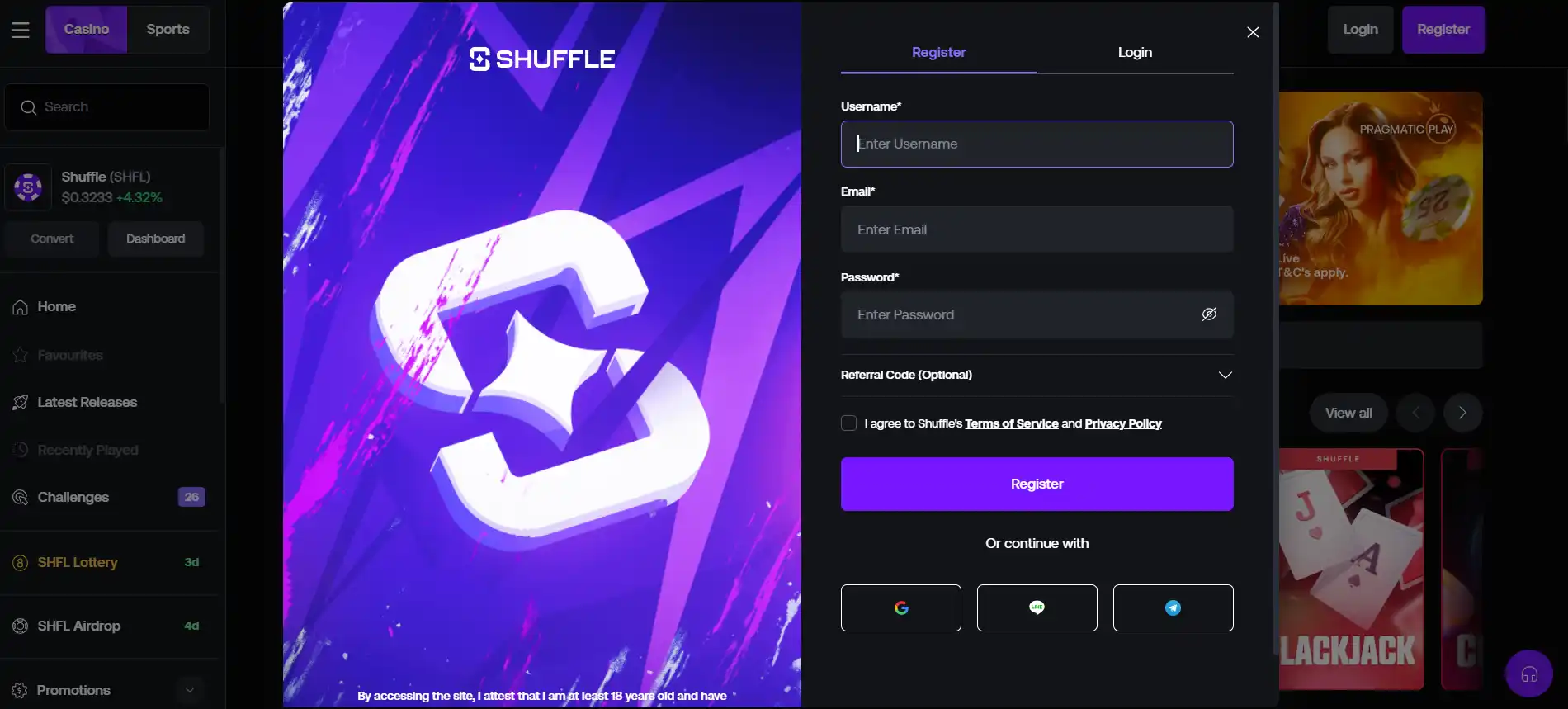
Shuffle’s onboarding starts with a short email registration form. Crypto deposits then use a wallet-based payment flow, so the first steps can feel lightweight compared with a service that asks for identity documents before the first transaction.
- Sign-upShort email registration
- Deposit pathCrypto wallet flow
- KYC modelRisk-based, with ID required before first withdrawal
- First withdrawalGovernment-issued ID check required
The important distinction is between onboarding and the full lifecycle of an account. An account that opens with little friction can later be asked for government ID, proof of address or a liveness/selfie check. That possibility becomes especially relevant when money is moving out rather than in.
For the payment side of that journey, the Shuffle payments guide explains coin and network handling. The withdrawal guide focuses on cashout timing, variable minimums and verification friction.
The account journey can change at withdrawal
A practical way to think about the account is as a sequence rather than a single registration event. Early steps can remain simple, while later steps can require more evidence depending on the account and transaction.
- Create the account through the email registration flow.
- Choose a supported crypto asset and the correct network before depositing.
- Use the casino normally, keeping payment and account details consistent.
- Request a withdrawal when ready to cash out.
- If the account is selected for additional checks, provide the requested identity or address evidence before the withdrawal can continue.
The account can face additional checks at different stages, but the first withdrawal has a clear identity requirement. Shuffle may also request further KYC, address, payment-instrument or source-of-funds evidence when its risk controls call for it.
Entry friction can be low
Email registration means identity-document collection does not necessarily happen at the opening screen.
Cashout can be the turning point
A withdrawal can move the account from routine transaction handling into an identity-review process.
First withdrawal has a clear identity requirement
A government-issued identity-document check applies before the first withdrawal, while further checks can be requested when necessary.
Shuffle uses risk-based KYC and requires ID before the first withdrawal
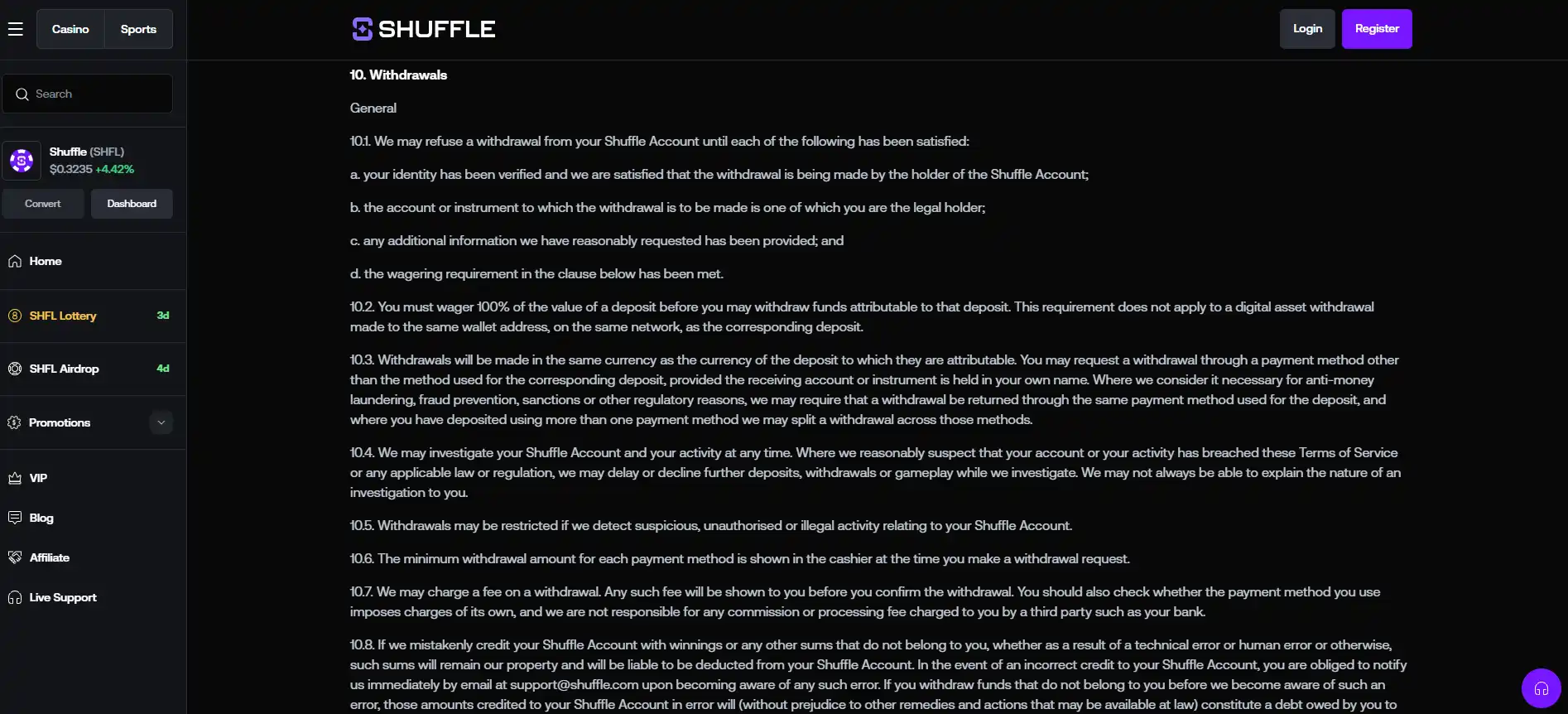
Shuffle can request KYC documentation at any time when it considers a check necessary. Its terms state that a government-issued identity-document check may be required at a threshold set by the operator and, in any event, before the first withdrawal. Proof of address, payment-instrument checks, database checks and selfie verification can also be used.
| Account stage | What can happen | What to prepare for |
|---|---|---|
| Registration | Short email onboarding | Use an email address you can continue to access |
| Deposit | Crypto wallet transfer | Match the asset and network shown in the payment flow |
| Before first withdrawal | Government-issued identity-document check | Have a valid passport, ID card or driving licence ready |
| Risk-triggered review | ID, address or liveness evidence may be requested | Be ready to supply clear, current documents if asked |
| Additional review | Address, payment or source-of-funds evidence may be requested | Keep account and transaction records consistent |
That structure is why “no-KYC” is the wrong shorthand for Shuffle. Identity-document checks apply before the first withdrawal, and additional review can be requested when the account requires it.
The terms also allow Shuffle to restrict payments or withdrawals until identity has been established to its satisfaction. Source-of-funds or source-of-wealth evidence can be requested, and a payment method used for deposits or withdrawals may need to be shown as belonging to the account holder. These checks are separate from the blockchain transfer itself and can therefore affect cashout timing before any transaction is broadcast.
Prepare for the documents that may be requested
Shuffle accepts government-issued identity documents for proof-of-identity checks and can request proof of address for a higher verification level. Its terms also allow electronic checks, payment-instrument validation, database checks, selfie verification and source-of-funds or source-of-wealth evidence when required.
Useful preparation
- Keep a current government-issued identity document available.
- Use address information that matches the evidence you could supply if asked.
- Maintain access to the email used for the account.
- Keep transaction records that help you trace deposits and withdrawals.
Assumptions to avoid
- Do not assume a previously unverified account can never be checked later.
- Do not assume a small earlier withdrawal predicts the process for a larger later one.
- Do not send identity material outside the platform’s normal support or verification path.
- Do not assume that completing one identity step prevents further account checks later.
If a dispute develops around an account review or withdrawal, keep copies of the request, your response and relevant transaction details. The separate safety and dispute guide covers the broader escalation context without changing the account-level steps above.
Large withdrawals can add verification friction
Withdrawal processing and account review are separate stages. A blockchain transfer can begin only after the account-side requirements are satisfied, so identity or source-of-funds checks can add time before a transaction is released.
- Routine cashout
- Timing depends on account processing and the selected blockchain network.
- Risk trigger
- Can move the account into an additional review before funds are released.
- First withdrawal
- An identity-document check applies before funds can be released.
- Further review
- Shuffle can request address, payment-method or source-of-funds evidence when additional due diligence is required.
The practical response is to separate “how fast does Shuffle usually process a normal withdrawal?” from “could my specific account be reviewed first?” The first can be fast. The second can add a variable delay that no public threshold lets you predict exactly.
Treat identity data as part of account security
Account security is not only about passwords or wallet addresses. Identity documents, contact details and transaction histories can be sensitive too. In October 2025, Shuffle notified users about a data incident involving third-party CRM/email provider Fast Track. The notice described exposed names, email addresses, addresses, transaction data and betting data.
The user notice stated that Fast Track did not hold passwords or login credentials and that player funds remained secure. The incident still matters when deciding how much personal information sits around an account, especially if a later KYC review requires identity documents.
- Use a unique password for the email account connected to gambling services.
- Treat unexpected messages about verification or withdrawals as potentially sensitive until you confirm the request through the normal account channel.
- Keep copies of documents you submit and note when they were provided.
- Review account and email security after any public incident involving personal data.
These steps do not change Shuffle’s verification policy. They reduce the number of avoidable mistakes around identity data when an account moves from simple email onboarding into a document-based review.
Common Shuffle account questions
How do I create a Shuffle account?
Shuffle uses a short email registration flow. Crypto deposits then move through a wallet-based payment process.
Is Shuffle a no-KYC casino?
KYC can be requested when necessary, and the first withdrawal requires a government-issued identity-document check. Proof of address and selfie checks may also be requested.
When can Shuffle ask for identity documents?
Shuffle can request KYC at any time when necessary, and it requires a government-issued identity-document check before the first withdrawal.
Can KYC delay a Shuffle withdrawal?
Yes. Routine withdrawals can be fast, but a withdrawal that triggers account verification can take longer while the requested checks are completed.
What information was involved in Shuffle’s 2025 data incident?
In October 2025, Shuffle notified users about an incident involving third-party provider Fast Track. The notice described names, email addresses, addresses, transaction data and betting data as exposed; it said passwords or login credentials were not stored with Fast Track and player funds remained secure.
A simple Shuffle sign-up can still lead to full identity checks
Shuffle’s account flow starts with email, but identity checks are part of the withdrawal lifecycle. A government-issued identity-document check applies before the first withdrawal, and further address, payment or source-of-funds evidence may be requested when additional review is required. Plan around that possibility before depositing, and treat identity data with the same care as wallet and transaction details.