Crypto payment guide
Shuffle Payments Across Coins, Networks and Withdrawals
Shuffle supports a broad crypto set and several blockchain routes, including multi-chain options for USDT and USDC. The practical rule is simple: treat the asset and network as one payment choice. The minimum cryptocurrency deposit is $0.01 or the crypto equivalent, withdrawal minimums vary by asset, and account checks can delay a cashout before a blockchain transaction is released.
The Shuffle payment map at a glance
The supported-asset list covers BTC, ETH, SHFL, LTC, USDT, USDC, TRX, POL, XRP, SOL, DOGE, BNB, AVAX, GRAM, SHIB, BONK, WIF, TRUMP, PUMP and DAI. Several assets support more than one blockchain route, so the coin and network must be selected together.
- Core assetsBTC, ETH, SHFL, LTC, USDT, USDC, TRX, POL, XRP, SOL, DOGE, BNB, AVAX, GRAM, SHIB, BONK, WIF, TRUMP, PUMP, DAI
- Stablecoin routesUSDT and USDC use multiple supported chains
- Minimum deposit$0.01 or crypto equivalent
- Minimum withdrawalVaries by coin
- Withdrawal paceRoutine withdrawals are fast; checks can add delay
- Transfer chargeNetwork fee is shown at confirmation
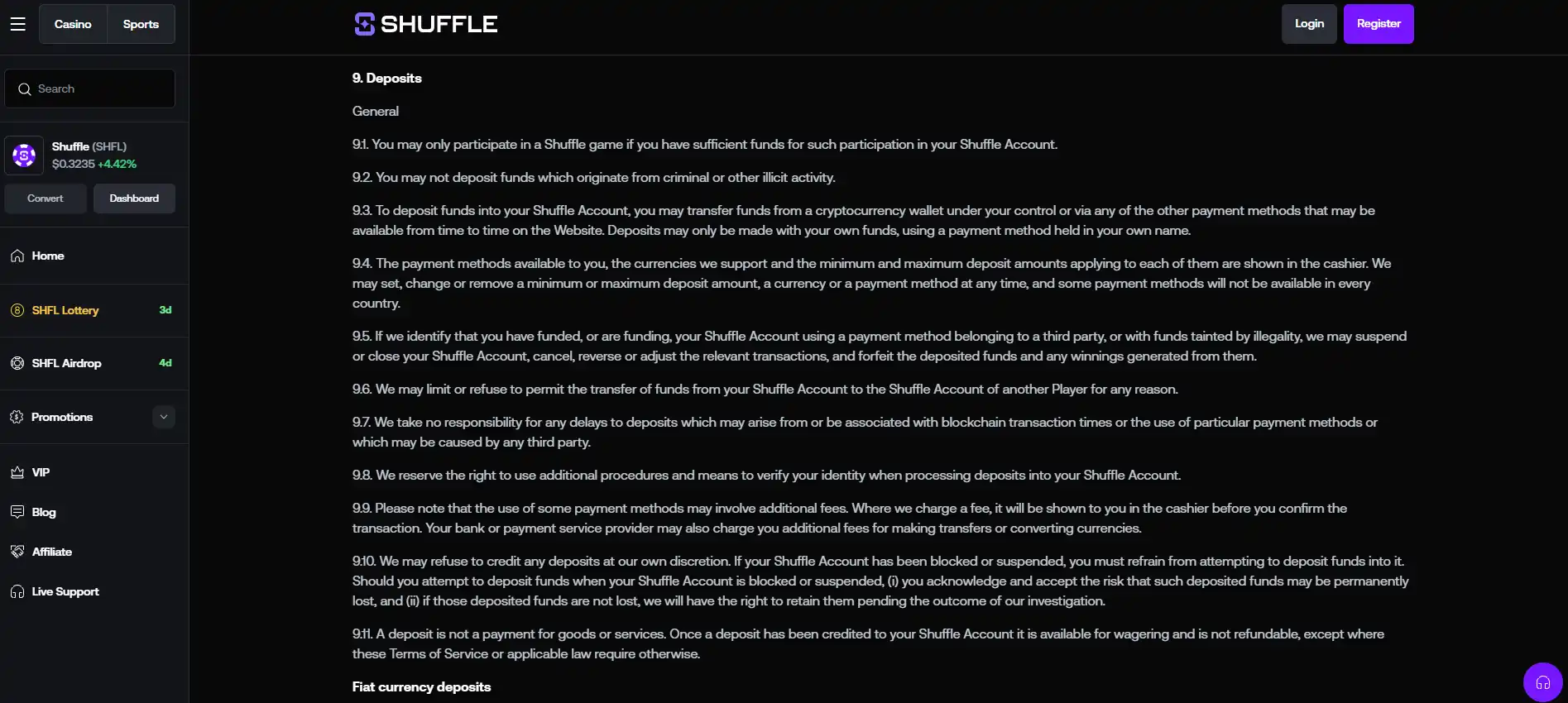
The cryptocurrency minimum deposit is $0.01 or the equivalent value across supported assets. Withdrawal minimums are different: they depend on the selected coin and are shown in the withdrawal window before submission.
A ticker is not a route. “USDT” tells you the asset; ERC20, BEP20, TRC20 or Polygon tells you how that asset is moving. Both sides of the transfer need to match.
If your main question is cashout friction rather than asset support, the dedicated Shuffle withdrawals guide separates network checks, amount limits and identity-review triggers. The account guide explains why a larger withdrawal can become an account-verification event.
Coins and networks need to match
The table below pairs each listed asset with its supported blockchain route or routes. The deposit minimum is $0.01 or the crypto equivalent; withdrawal minimums remain asset-specific.
| Coin | Supported network or networks |
|---|---|
| BTC | Bitcoin |
| ETH | Ethereum / BEP20 / Base / Robinhood Chain |
| SHFL | ERC20 |
| LTC | Litecoin |
| USDT | ERC20 / BEP20 / TRC20 / Polygon / Solana |
| USDC | ERC20 / BEP20 / Solana / Polygon / Base / Arbitrum |
| TRX | Tron |
| POL | Polygon / Ethereum |
| XRP | XRP Ledger |
| SOL | Solana |
| DOGE | Dogecoin |
| BNB | BNB Chain |
| AVAX | Avalanche |
| GRAM | TON |
| SHIB | ERC20 |
| BONK | Solana |
| WIF | Solana |
| TRUMP | Solana |
| PUMP | Solana |
| DAI | ERC20 |
The deposit floor is platform-wide, while withdrawal minimums and network charges remain transaction-specific. The wallet shows the applicable withdrawal minimum and charge for the selected asset before submission. The safest operational sequence is to choose the asset, read the offered network, then copy the address or destination details only after those two choices agree.
Stablecoins make the network choice visible
USDT and USDC are the clearest examples of why network matching matters at Shuffle. USDT supports ERC20, BEP20, TRC20, Polygon and Solana. USDC supports ERC20, BEP20, Solana, Polygon, Base and Arbitrum. The balance may still be denominated in the same token, but the sending wallet and receiving address must agree on the chain.
USDT
Supported routes include ERC20, BEP20, TRC20, Polygon and Solana. Do not select a chain simply because it is cheaper or familiar; select the one shown for the transaction.
USDC
Supported routes include ERC20, BEP20, Solana, Polygon, Base and Arbitrum. The token symbol stays the same while the destination network changes.
Native assets
BTC, LTC, SOL, XRP, TRX, BNB, DOGE, AVAX and GRAM use their listed native or named networks, while ETH and POL also support more than one route.
A useful mental model is “asset + chain + destination,” not just “coin + address.” The address format may help you spot a mismatch, but address appearance alone is not a substitute for reading the selected network on both sides. If your wallet offers several withdrawal networks for one token, compare the names line by line before sending.
Before you send
- Match the asset ticker in both interfaces.
- Match the network name in both interfaces.
- Review the minimum and network fee shown for that route.
- Recheck the destination details before confirming an irreversible transfer.
Common routing mistakes
- Choosing the cheapest network without checking whether the destination supports it.
- Assuming all USDT or USDC balances use one chain.
- Using an old minimum or fee from a previous transaction.
- Copying an address before selecting the network in the payment dialog.
A deposit is a wallet-to-wallet routing task
Shuffle’s onboarding uses a short email registration flow, after which crypto deposits are made from an external wallet. The site also presents fiat access through payment partners, but crypto remains the cleanest way to understand the payment mechanics because the user controls both the sending wallet and the selected blockchain route.
- Open the deposit flow and choose the asset you intend to send.
- Select or read the network shown for that asset. For a multi-chain stablecoin, this is a separate decision from the ticker.
- Read the $0.01 deposit minimum and the network details displayed for the route before sending.
- Set the same network in your external wallet, then copy or scan the destination details.
- Confirm the transfer only after asset, network and destination all match. Crypto transactions can be irreversible once broadcast.
Shuffle sets the cryptocurrency deposit minimum at $0.01 or the crypto equivalent across supported assets. The network still matters for routing, fees and destination details, while withdrawal minimums remain coin-specific and are shown separately in the wallet.
If a wallet supports an address book, label saved destinations with both the service and the network. “USDT — TRC20” is safer than a generic “casino USDT” label when the same token can travel on several chains.
Routine withdrawals are fast until extra checks enter the flow
Routine Shuffle withdrawals are described as fast, typically completing within a day, but that is not a deadline or a guarantee. Larger wins can trigger identity checks, which moves the process from pure transaction handling into account verification. That is why cashout speed should be thought of as two clocks: blockchain/payment processing and any account review that happens before release.
Minimum withdrawal
Varies by coin rather than using one platform-wide amount.
Routine pace
Fast for ordinary withdrawals, without a guaranteed completion time.
Large cashouts
Can trigger ID checks and additional delay.
Withdrawal caps
No daily, weekly or monthly platform cap is stated in the current payment terms.
Fee display
Network charges are shown at the confirmation stage.
Shuffle’s current payment material states that daily, weekly and monthly withdrawal caps do not apply. Coin-specific withdrawal minimums still apply, and the wallet shows the relevant minimum before the request is submitted.
If a withdrawal stops being routine, the most useful next question is whether the hold is transactional or account-related. A network issue, an amount limit and an identity request need different responses. The withdrawal guide maps those friction points in detail, while the account guide covers the risk-based verification process.
Fees, volatility and finality sit outside the casino balance
The withdrawal flow shows the applicable charge before confirmation. That still does not make a crypto transfer costless. Network conditions, wallet-side fees and the market value of the asset can all affect what a transfer feels like in fiat terms.
The fee and the asset value are different risks. A network fee is the cost of moving the transaction on the chosen chain. Volatility is the possibility that the asset’s market value changes while you are holding or moving it. Neither one is a reason to predict future prices; they are reasons to separate “how many units moved” from “what those units were worth at a particular moment.”
Crypto transfers are usually irreversible. Recheck the asset, network and destination before confirming, and do not rely on a later support request to undo a blockchain routing mistake.
For bonus users, payment mechanics can also interact with wagering rules after the deposit lands. The Shuffle bonus guide explains the 35x deposit-plus-bonus requirement separately so transaction routing and promotion arithmetic do not get mixed together.
Common Shuffle payment questions
Which cryptocurrencies does Shuffle support?
Shuffle currently accepts BTC, ETH, SHFL, LTC, USDT, USDC, TRX, POL, XRP, SOL, DOGE, BNB, AVAX, GRAM, SHIB, BONK, WIF, TRUMP, PUMP and DAI.
Which networks can I use for USDT at Shuffle?
For USDT, Shuffle lists ERC20, BEP20, TRC20, Polygon and Solana routes. Match the network in your wallet to the network shown in the payment dialog.
Does Shuffle have one minimum deposit?
Yes. The cryptocurrency minimum deposit is $0.01 or the crypto equivalent across supported assets.
What affects Shuffle withdrawal speed?
Cashout timing depends on both account-side processing and the blockchain network selected for the transfer. Identity checks can add time before a transaction is released.
Does Shuffle charge a withdrawal fee?
Shuffle information describes network charges shown at confirmation and does not identify a separate platform withdrawal fee. Read the final confirmation screen because network costs can vary.
What happens if I choose the wrong network?
A mismatched blockchain route can put funds at risk because crypto transfers can be irreversible. Match the asset and network in the external wallet to the route shown for the Shuffle transaction before sending.
Read next
- Map Shuffle withdrawal friction and cashout checks
- Understand account verification around larger withdrawals
- Separate bonus wagering from payment mechanics
- Return to the full Shuffle review
Shuffle payments work best when the route matches the selected asset
Shuffle’s payment strength is breadth: major crypto assets, several named blockchain networks and multi-chain stablecoin routes. The trade-off is that there is more to verify before a transfer. Minimums depend on the active asset or network, network fees appear at confirmation, routine withdrawals are fast without being guaranteed, and larger cashouts can move into identity review. Treat every transfer as an asset-and-network pair, read the live payment dialog, and keep the transaction record after funds move.
Written by the editors at Shuffle.