
Crypto cashout guide
Shuffle Withdrawals From Balance to External Wallet
Shuffle withdrawals do not run on one universal minimum or one guaranteed clock. The minimum varies by coin, routine cashouts are generally fast, larger wins can trigger identity checks, and the final blockchain transfer is irreversible once sent. The useful way to plan a cashout is to separate amount, account review and network routing instead of treating “withdrawal speed” as a single number.
The cashout friction map separates three different problems
A withdrawal can slow down for three very different reasons: the selected coin has its own minimum or route, the account is sent through an identity check, or the blockchain transfer itself is still moving. Those are not interchangeable delays, and each one needs a different response.
- Minimum withdrawalVaries by coin
- Routine cashoutsGenerally fast, without a guaranteed deadline
- Larger winsMay trigger identity checks
- Platform withdrawal capsNo daily, weekly or monthly cap stated
- Withdrawal chargeNetwork fee shown at confirmation
| Friction point | What changes | What to check |
|---|---|---|
| Coin minimum | The amount needed to submit a withdrawal depends on the selected asset. | Read the minimum shown for that coin in the withdrawal dialog. |
| Account review | A larger or risk-triggered cashout can require identity checks before release. | Check account notices and requested documents before focusing on blockchain timing. |
| Network transfer | Once released, the withdrawal moves on the chosen blockchain route. | Match the destination network and keep the transaction record. |
This distinction matters when you troubleshoot. A coin minimum is solved in the payment flow. An identity request belongs to the Shuffle account and KYC process. A routing issue belongs to the broader Shuffle payments guide. Treating all three as “the withdrawal is slow” makes it harder to identify what actually needs attention.
Start with the stage, not the stopwatch. First ask whether the request has been accepted, whether account verification is pending, and whether a blockchain transaction has been released.
Minimums vary by coin and platform time caps are not stated
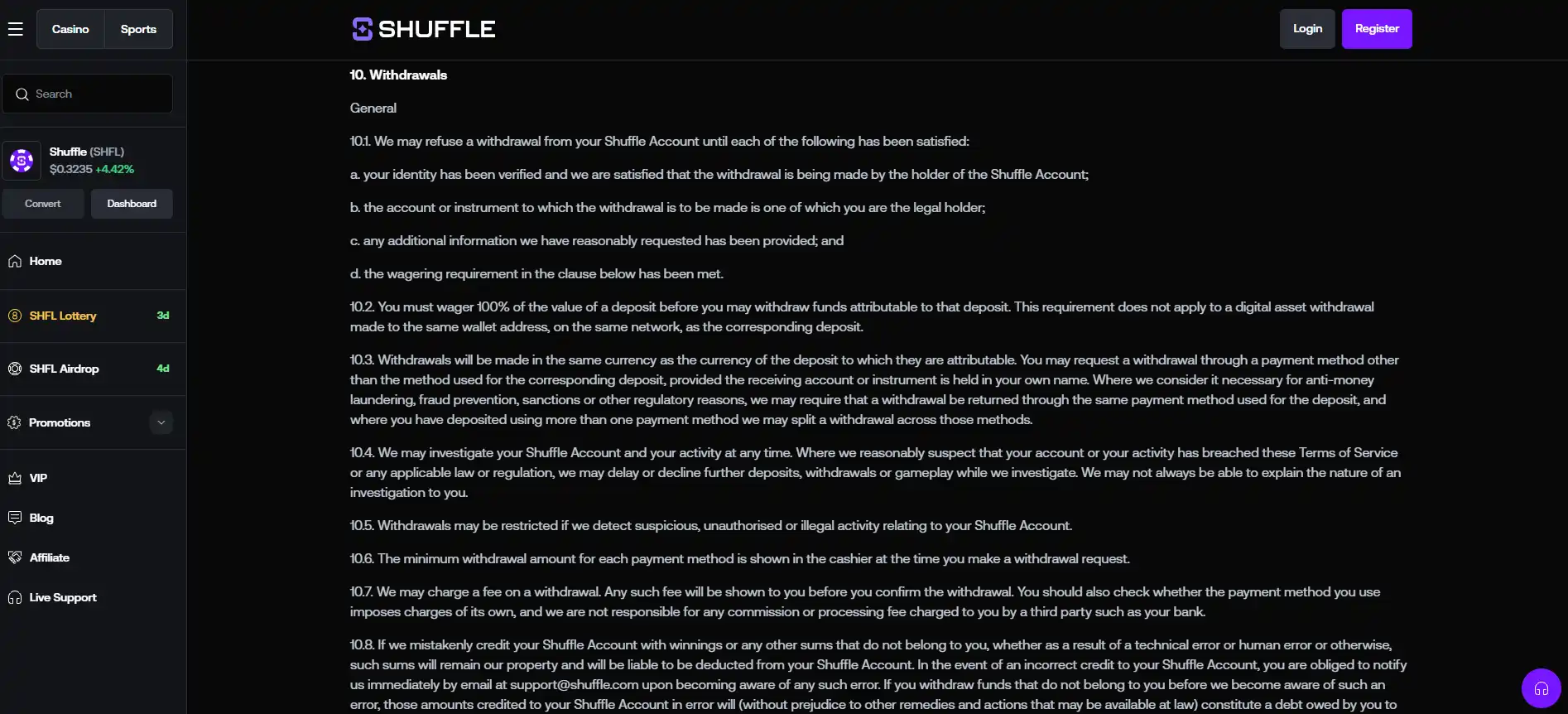
Shuffle does not use one platform-wide minimum withdrawal. The threshold depends on the coin. The current BTC minimum is 0.00015 BTC plus the network fee, while other assets use their own minimums shown in the withdrawal window.
Minimum structure
Coin-dependent rather than one fixed platform number.
BTC minimum
0.00015 BTC plus the network fee.
Platform caps
No daily, weekly or monthly withdrawal cap is stated.
Fee display
Network charges appear at confirmation.
Daily, weekly and monthly platform withdrawal caps are not stated in Shuffle’s current payment material. Coin-specific minimums still apply, and account checks can restrict a withdrawal until the required identity and payment conditions are satisfied.
For common assets, the withdrawal floor can differ substantially: current Shuffle payment information lists 0.00015 BTC, 0.005 ETH, 0.06 LTC, 0.1 SOL, 10 USDT and 10 USDC, with the applicable network charge added or displayed for the transaction. These figures are asset-specific rather than interchangeable, so switching from one coin to another changes the minimum even when the fiat value of the planned cashout is similar.
A minimum is route-specific
The amount that can be withdrawn depends on the selected asset. That makes a remembered “casino minimum” less useful than the current value shown for the coin you are actually using.
Account checks are a separate constraint
A withdrawal can remain unavailable while identity, payment-method or source-of-funds checks are incomplete. Those account-side conditions are separate from the blockchain network and coin minimum.
Fees sit outside the balance amount
The network charge shown at confirmation changes what leaves the transaction flow. Read it before submitting rather than assuming that the requested withdrawal and the received wallet amount will always match exactly.
Identity checks are part of the withdrawal process
Shuffle can request KYC documentation whenever it considers a check necessary. Its terms require a government-issued identity-document check before the first withdrawal, and additional address, payment-instrument, database, selfie or source-of-funds checks can be required when appropriate.
Prepare before a large cashout
- Keep the account email accessible.
- Have a valid government-issued identity document ready before the first withdrawal.
- Keep address information consistent with the account details you provide.
- Save the withdrawal request and any support correspondence.
Do not read a hold as one specific cause
- A pending review is different from a blockchain transfer that has already been sent.
- A requested document is an account issue, not a network-fee issue.
- A larger or unusual transaction can lead to additional due-diligence questions.
Document readiness and record-keeping matter because Shuffle can withhold a withdrawal until required KYC and payment checks are complete. Keep the request, account messages and transaction details together so an account-side hold can be distinguished from a blockchain issue. If a dispute goes beyond ordinary support, the Shuffle license and dispute guide explains the available escalation context without assuming that one country’s rules apply globally.
Do not describe Shuffle as a no-KYC or anonymous casino. A government-issued identity-document check applies before the first withdrawal, and further checks can be requested when necessary.
Fees and network choice shape the final transfer
Once a withdrawal is released, the remaining risk is mostly operational: the destination and network have to match, and the blockchain transfer cannot normally be reversed. Shuffle’s withdrawal flow shows the applicable charge before confirmation.
That does not make every cashout costless. The amount received can still be affected by the network charge, and the fiat value of the asset can move while funds are held or in transit. Those are separate effects: one is a transfer cost, the other is crypto volatility. Neither tells you whether the asset will rise or fall next.
- Select the asset you want to withdraw and read its current minimum.
- Confirm the destination wallet supports the same blockchain route shown for the withdrawal.
- Read the network charge before submitting the request.
- If the account is asked for identity checks, complete that stage before expecting a blockchain transaction.
- After release, save the transaction reference and verify the destination independently.
For multi-chain assets, label saved wallet destinations with both token and network. A generic token label can be ambiguous when the same asset exists on several chains.
A safer withdrawal sequence checks the account before the chain
There is a simple order that keeps the moving parts separate. First, check whether the amount is valid for the selected coin. Second, confirm that no account review is blocking release. Third, once a transaction exists, verify the blockchain route and destination. Reversing that order can lead to wasted troubleshooting, because there is no network transaction to inspect while a withdrawal is still waiting on account review.
Withdrawal speed depends on account processing and the selected network. KYC or other due-diligence checks can add time before release, while blockchain confirmation time begins only after a transaction is broadcast.
If the cashout is part of a wider crypto workflow, keep the deposit and withdrawal records together. That makes it easier to match the original asset and network, explain the movement of funds if verification is requested, and separate account questions from blockchain questions later.
Common Shuffle withdrawal questions
What is the minimum Shuffle withdrawal?
The minimum depends on the coin rather than one platform-wide number. Shuffle currently lists a 0.00015 BTC minimum withdrawal plus the network fee. Other assets have their own minimums, which are shown in the withdrawal window.
What determines how long a Shuffle withdrawal takes?
Withdrawal timing depends on account processing and the selected blockchain network. Required identity checks can postpone release before the blockchain transaction begins.
Can Shuffle ask for KYC during a withdrawal?
Yes. Shuffle can request KYC at any time, and a government-issued identity-document check applies before the first withdrawal. Additional address, payment or selfie checks may also be required.
Does Shuffle have a withdrawal limit?
Shuffle’s current payment information states that daily, weekly and monthly withdrawal caps do not apply. Coin-specific minimums and account checks still apply.
What fee can appear when withdrawing from Shuffle?
The withdrawal window shows the charge before confirmation. The exact network cost can vary by asset and route.
What should I keep after a crypto withdrawal?
Keep the withdrawal request, any account-review messages and the blockchain transaction reference after release. Those records help separate support, verification and network issues if something needs to be traced.
Read next
- Compare coins, networks and payment routes
- Understand risk-based account verification
- See the dispute and license context
Shuffle cashouts are easiest to read as a three-stage process
The cleanest way to manage a Shuffle withdrawal is to separate the coin rules, the account review and the blockchain transfer. Minimums vary by asset, daily, weekly and monthly platform withdrawal caps are not stated, and identity checks apply before the first withdrawal. Once funds are released, network choice, the displayed fee and transaction finality become the main concerns. Check the stage first, then solve the problem that belongs to it.
Prepared by the Shuffle editorial staff.